
 العربية
Specifications of oils and grease

Lubrication oils
Lubrication oil consists of:
Base oil
+ Plugins
1- Basic oil is responsible for the viscosity of oil:
Base oil resulting from refining operations of crude oil derivatives products
2– The addition is responsible for the performance level:
The addition is imported from additive manufacturers and they are 4 companies worldwide due to
For high cost and technology for manufacturing processes (Chevron- Lubrezul-Afton-Infinim)
- Crude oil consists of carbon and hydrogen components (H C) and when distillation processes are produced for the production of essential oils compounds are:
1- Paraffin compounds: – a straight series of hydrocarbons H C characterized by these oils (high viscosity factor – high spill level – high resistance against oxidation – contains a percentage of candles) and therefore is considered excellent lubrication oil
2- Puffin compounds: – a loop installation of H C and characterized by (low degree of spill – weak resistance against oxidation – contains a percentage of asphalt)
3. Arumat vehicles:
They are unsaturated aromatic compounds that are easy to relate to any other part and have properties.
(Weak resistance to oxidation – no degree of spill)

Essential oils are divided into 6 groups:
- -Group 1 contains less than 90% of the silo and the sulfur rate is greater than 0.3% and the viscosity factor of 80:120
- Group 2 – contains more than 90% of the silo and sulfur content is greater than 0.3% and the viscosity factor of 80:120
- Group 3 – contains more than 90% of the silo substances and the sulfur rate is greater than 0.3% and the coefficient is greater than 120
- Group 4 – Oils made from poly-alpha olivat (PAO)
- Group 5 – All oils that have not been described in previous collections
- Group 6 – Oils made from pio
Essential oils are produced by refineries and there are some types imported from abroad and the specifications of each oil differ from the other according to technical specifications:
– For the face at 40, 100 degrees cential
– Al-Zujja Factories
– Open flash temperature – closed flash temperature
– Spill temperature
– Total base degree – total acidity degree
- Color grade – appearance degree (to see if there is wax or not)
- Rate of magnifying ash
- The viscosity of the oils used is determined according to the recommendations of companies and international equipment manufacturers, whether for engine oils or industrial oils.
1-( SAE ) Society Of Automotive Engineers
American Automobile Engineers Association
2-(ISO) international Organization For Standarization
International Authority for Standardization
The performance level is determined by the additions used and their types:
- 1- Antioxidant additives
- 2- Anti-wild additions, scratching and friction.
- Anti-corrosion additives.
- 4- Clean and dispersed additives.
- 5- Spill-reducing additions.
- Improved additions to viscosity factor
- 7. Improved oil resistance additives for fungi and bacteria.
- 8- Multifunctional additions that improve more than especially at the same time.
– (IP) Institute Of Petroleum
British Petroleum Institute of Tests
– (AGMA) American Gear Manufacturers Association
American Gearmakers Association
– (ACEA) Association Of European Automotive Manufacturers
European Automobile Manufacturers Association
There are other performance levels for individual engine producers.
Split lubrication oils
- engine oils
- industrial oils
- marine oils
- specialty oils
Split lubrication oils
Engine oils are divided into:
- DEO/Diesel Engine Oils
- and PCMO/Passenger Car Motor Oils
- and gas oils
- and internal combustion is done in diesel engines by pressure
- and the internal combustion of gasoline engines is carried out by ignition spark.
- symbolizes diesel oils in performance levels with the symbol C short for the word commercial commercial
- and symbolizes gasoline oils with the symbol S abbreviated to the word service service
Gas engine oils depend on the percentage of magnifying ash, whether empty or 0.1: 0.6
American Petroleum Institute division of gasoline engine oils
American Petroleum Institute division of gasoline engine oils
API SA-SB: Cancelled (
Until 1964 — old engines
– The lowest types of gasoline engines in performance
API SC: Cancelled
From 1964 to 1967 –
For gasoline engines.
API SD: Cancelled
Higher control – control of impurities protection
From 1967 to 1971 – higher than SC
– API SE: Cancelled
From 1972 to 1979 – higher than SD
Higher protection + high oil protection from oxidation
– API SF (working so far)
From 1980 to 1988 – higher than SE
Higher protection against corrosion – stability against oxidation
– API SG – SH Cancelled
From 1989 to 1996 – higher protection – protection against evaporation and foam
– API SJ is still working so far
From 1997 to 2001 — Protection of sports car requirements
– API SL is still working so far
From 2001 to 2009 – Higher Protection
— API SM is still working
From 2009 to now – higher than SM
Higher oxidation protection – high engine cleaning – achieving environmental requirements
American Petroleum Institute division of diesel engine oils
American Petroleum Institute division of diesel engine oils
API CA cancelled – introduced from 1940 to 1950
Diesel internal combustion engine with light pressures with high quality fuel
API CB cancelled – introduced from 1951 to 1960
Necessary protection against eating and impurities — fueling sulfur traces
API CC cancelled – introduced from 1960 to 1961
Give higher protection to medium-loaded diesel engines
– API CD still works – working period from 1961 to 1986
Heavy service diesel engines – diesel engines
– API CF is still working – his term of office from 1987 to 1994
Diesel engines are indirect injections that have high sulfur fuel.
API CF – 4 cancelled – working period from 1990 to 1994
High-performance diesel engines with high oil protection against impurities
– API CG – 4 1994
Heavy-duty diesel engine service – piston deposit processing – corrosion reducing foam formation – oxidation stability – achieving exhaust emission standards
API CH-4– 1998 – 2001
API CI-4 has been operating since 2002 until now.
Heavy diesel engine service – exhaust emission standards 2004 – exhaust gas recycling engines – exceeding all API performance levels
industrial oils
- the performance levels of industrial oils are divided by equipment manufacturers:
- – German DIN
- – U.S. Army
- – GE
- – General Motors
- – DENSON HF
- – Cincinnati Machine
of the most famous industrial oils: –
- – Soil oils
- – Hydraulic oils
- – Industrial gear oils
- – Hepoid oils (manual movement transport oils)
- – Compressor oils (air compressors)
marine oils
– Marine oils depend on the total base number due to the conditions of the use of these oils in engines in which gasoline, which contains a high percentage of sulfur, which leads to increased acidity formation and needs to be resisted using the addition of a base-grade lifter
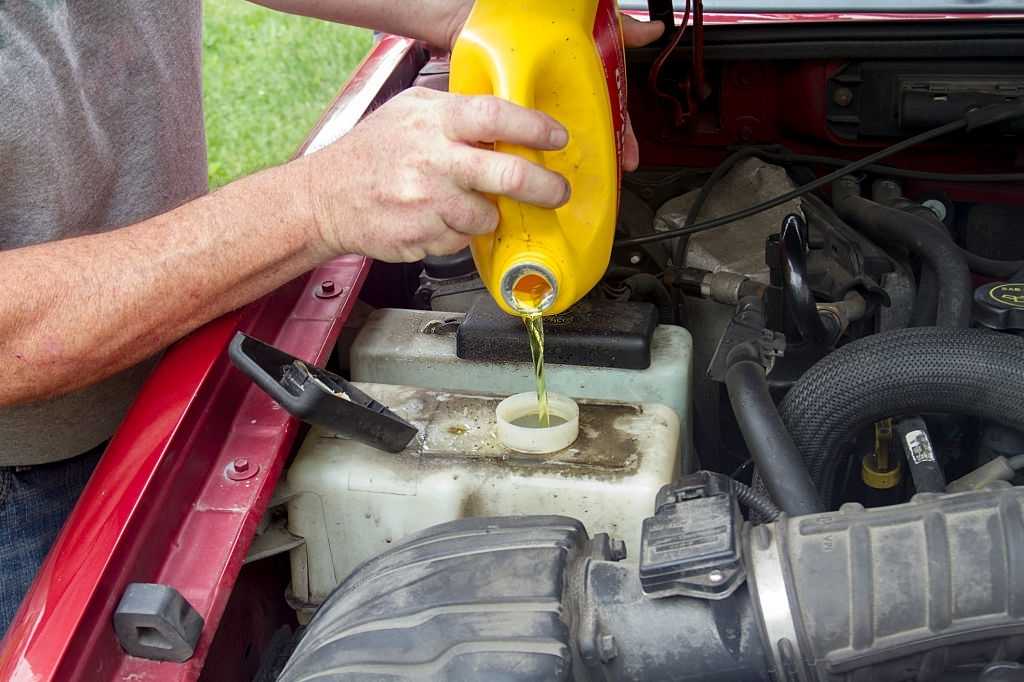
- One of the most famous marine oils:
- TBN 7 Marine Engines
- TBN Auxiliary Marine Engines 12:15
- Super Marine Engines 30 TBN
- Marine Biz 40 TBN engines
- Mediam Marine Biz 70 TBN
- Hefei Marine Biz 90TBN
specialty oils
– Cutting oils
– Rolling oils
Textile oils
– Kauchuk oils
– Rust contraindication oils
Types of additions
- 1 – Antioxidant additives
- – Anti-wild additions, scratching and friction.
- 3- Corrosion additives.
- – Clean and dispersed additives.
- – Spill-reducing additions.
- Improved additions to the viscosity guide.
- – Improved oil resistance additives for fungi and bacteria.
- – Multifunctional additions that improve more than especially at the same time.
Grease
- Definition of tallow
- Using grease
- Grease ingredients
- Types of grease
- How to manufacture grease
- Grease tests
- Division of grease
- Receiving, storing and trading grease
1– Grease is a solid or semi-liquid composition as a result of the dispersion of a thick substance for the piles in oil (such as sponge in water)
2- The use of grease (machines that are exposed to dust and humidity – places where oil leaking occurs – insufficient quantity of oil – not suitable for the wife of oil in these places – high loads and high speed)
3- Grease ingredients (soap + base oil + additives)
Types of additives (maximum pressure – oxidation resistance – resistant to eating – stainless – sticky)
4- Types of grease (calcium, lithium, sodiomi, silicone)
- Grease types depend on the type of base (alkaline material) manufactured from which grease – and the properties of grease depend on (appearance – stitches)
1- Calcium grease (strength of buttery and soft – insoluble in water – used in lubrication of simple chairs – operating temperature 60 m – drip degree from 90 m: 100 m)
2- Sodium grease (consisting of rubber leafy – water soluble – used in lubrication of wear and tear chairs – operating temperature 80 m – drip degree from 130 m: 150 m)
3- Lithium grease (soft texture – resistant to water and humidity – operating temperature up to 130 m – drip degree from 160 m: 180 m – used in lubrication of wear and tear chairs in a wide range of temperatures and high speeds) lithium grease is considered most commonly used than other greases
4- Silicon grease: – It is not used in the composition of regular soap as in other greases but silicon is used to thicken oil to give the same shape of grease (oil + silicon) and is used at a temperature of up to 250 m and also water resistant and used at high speeds
Grease properties
- Is the extent to which grease conforms to specifications and evaluates its performance
– Stitching degree
It measures the hardness or softness of grease and defines the degree of stitches as the distance (by 1, mm) in which a measuring cone is inserted into the grease under the influence of weight and ground gravity for 5 seconds at 25 m (soft grease large stitch / dry grease a little stitch) and then conducts the test after the operation of grease 60 runs
- The degree of stitches is measured according to the following table and the tallow number is determined according to the division of the National Lubricating Grease Institute ( 000-00-0-1-2-3-4-5-6)
- Stitches (445/475-400/430-355/385-310/340-265/295-220/250-175/205-130/160-85/115)
- 00-000 Is used in gearboxes, 0-1-2 central lubrication, 2-3 general lubrication, simple chairs, no friction, wear and tear, and 4-5-6 some exposed chairs in old machines.
2- Drip degree
- It's the temperature at which grease begins to turn liquid.
- This test indicates the maximum operating temperature at which grease is repaired without losing its properties in the lubrication process.
- This test can distinguish between sodium, calcium and lithium grease.
- The temperature of the operation of the grease is about 50 m below the degree of drip
3- Load 4 Ball
The way the test works.
- 3 fixed bowls at the bottom + 1 moving top including a plate of grease – we put weights – and rotation for 10 seconds and see if the fusion occurred after the friction or did not involve and at any weight occurs (we start weighing 300 kg) and change wear and tear and repeat the same steps with different weights until we determine the weight at which the break-in occurs and the previous weight is 50 kg is the carrying of the jam

– Prevention against eating (possible test)
Any yes or dates during the operation occurs friction with the outer cover of it and results in eating for wear and tear (3 flat floors at the bottom + 1 top moving) including a plate of grease to make friction and prove a load 40 kg — rotating the device for an hour — then we unpack and wash the wear and tear well with acetone or any disinfectant to make it easier for us to determine the point at which you eat and measure the radius of this point under the microscope and be about 0.04 mm
5. Stability against oxidation
– Grease is oxidized either as a result of operating conditions (temperatures) or as a result of storage, the sediments of the gums and renishi are formed on the parts of the chairs resulting in the erosion of the grease and damage of its texture, so we use oxidant-resistant additives in which 20 mm of grease is placed in pump and exposed to oxygen under pressure of 110 lbs/square inch at a temperature of 21 0 Fahrenheit (100 m) And the time required to reduce oxygen pressure is determined and this indicates the rate of fat absorption of oxygen i.e. oxidation oxidation (if the period of grease resistance to oxidation is 50 hours the storage period is a year – if it is 150 hours / storage period of 3:2 years – if it is 500 hours / storage period 4 years)
6- Mechanical stability (rolling test)
- This test determines the ability of grease to resist the change in strength during operation – the first method: – the degree of stitches before and after operation is measured 100,000 runs
- – The second method: – This method boils down to the rotation of a dolphin with a certain weight inside a cylinder containing grease distributed within it with a thickness of 4mm that rotates at a speed of 160 laps per minute for 4 hours and is conducted at any temperature and measured the degree of stitches before and after operation
7- Oil warming
- One of the important characteristics of grease is the ability of grease to keep oil in the body of the soap and generally the blood of oil occurs either during storage in barrels or as a result of the exposure of grease to high temperatures and high pressures and grease is placed in a slanted position and we see the amount of oil separated from the soap after a certain time
8- Grease resistance to water
(Measuring the resistance of grease to the act of washing with water) since all grease even in cases where soap is water soluble has a certain ability to absorb small amounts of water without harming the composition of soap but large quantities affect the strength of grease that does not dissolve in water (and is tested by highlighting a stream of water to collide with the body of a chair that rotates at a specific speed and filled with grease at a temperature of 40 m 80 m) and measured the amount of grease that decreased or melted from the body of the chair with the effect of water washing
– Prevention against rust
One of the important properties of grease is its resistance to rust (grease has the ability to resist water) even sodium grease that is scarred in water, it resists water to the extent of 10% of the volume of grease, but the exposure of grease to larger amounts of water exposes grease to fading, leaving the chair without lubrication or rust protection.
(The chair is rotated and half submerged in water for two weeks and we see how resistant the grease is to rust and it is always assumed that there is no rust on the surfaces of the chairs)

General properties of oils
- ▸ Density
- ▸ Viscosity
- ▸ Viscosity coefficients
- ▸ Flash temperature
- ▸ Spill temperature
- ▸ The ability to separate water
- ▸ The ability to separate the air
- ▸ Oxidation resistance
- ▸ Land resistance
- ▸ Total rule number – total pH number
Density
- Density does not directly assess the performing properties of oils, but by which the chemical composition of the raw material from which the oils were obtained can be judged as well as the degree of purification of oils.
Viscosity
The definition of viscosity is the liquid resistance to transmission under the influence of gravity and viscosity determines the validity of the oil for use and since viscosity changes as the temperature changes it decreases by heating and increases by cooling so each oil must have a specific viscosity suitable for its working conditions.
- IP71 Measurement Methods – ASTM D445
- Viscosity measurement units (Sinty Stock- Sinty Boaz-Sepult -………)
- Global bodies that divide viscosity
- (SAE ) SOCITY OF Automotive Engineers
American Automobile Engineers Association
- (ISO) nternational Organization For Standarization
International Standardization Body
- (AGMA ) American Gear Manufacturer Association
Association of American GearMakers
Viscosity factor
- Definition of viscosity coefficient (the extent of oil collapse with high temperatures and the higher the number indicates the quality of the oil and its resistance to collapse)
- Viscosity coefficient is associated with hydrocarbons that enter into the composition of oil where the oil contained on ring hydrocarbons (few in number) is considered to have a high viscosity factor may reach (100) and the essential essential oil faisal up to (40) and sometimes may reach zero
- Test Method ASTM D2270 / IP 226
- The oils required for this feature have multi-grade motor oils, hydraulic oils and heating oils.

flashing degree
- The definition of the temperature of the flash is the temperature at which the fumes of the petroleum product begin to cause a flash and the degree of flash indicates the degree of flash in determining the oil's susceptibility to evaporation and volatilization and then ignition, and the low degree of flashing of oil indicates the presence of decomposition and disintegration products
- Test Method ASTM 93 CC IP35 OC
- Flash temperature is taken into account in oils during operation or storage
- Open flash for new oils and closed for used oils
- Spill temperature
- It is the lowest temperature at which the petroleum product spills, which is a very important characteristic for oils, which is 3 degrees centimeter before freezing.
- Test Method ASTM D 97 / IP 15 ˚
- This property is required for oils, especially cooling oils.
- The ability to separate water
- It is an important characteristic of turbine oils, circular compressors, hierolics and taurus, where the number of laps for turbines and compressors (from 4500:1500 p/m) indicates the extent to which the oil is separated from water and measured The time when 20ml oil is separated from 20ml water (40ml emulsion) is formed by steam emulsion, which is indicative of oil sussible to flush out water – the lower the separation time, the better the oil to flush the water.
- Test Method ASTM D 1401 Water Separation Time Test
- Test Method IP 19 steam emulsion test
- Oils required for this test in order
Tobinate oils – spinabin compressors – hedoliic and taurus
Resistance to foam formation
- The presence of air in the oil leads to the occurrence of foam and air can seep into oil during the work or as a result of other factors, and the formation of foam affects the functioning of the work and leads to the loss of part of the oil and this phenomenon depends on temperature, viscosity and surface tension of oil, as well as the good technique of oil leads to a decrease in the oil tendencies basis for the formation of foam, but one of the most effective ways to reduce foam is the addition of anti-foam additions
- – We make air foam for 5 minutes and set the landing time of this foam (0/0 there is no foam at the beginning or the end – 30/0 there is foam 30 mm when entering the air and when the foams fall after the air closes do not take time)
- Test Method ASTM D 892
- Unit Seq I ml / ml at 24 C
- Seq II ml / ml at 94 C
- Seq III ml / ml at 24 C after cooling from 94 C
- Oils required for this property turbine oils, hydraulic oils, gears and engines
- – We make air foam for 5 minutes and set the landing time of this foam (0/0 there is no foam at the beginning or the end – 30/0 there is foam 30 mm when entering the air and when the foams fall after the air closes do not take time)
- Test Method ASTM D 892
- Unit Seq I ml / ml at 24 C
- Seq II ml / ml at 94 C
- Seq III ml / ml at 24 C after cooling from 94 C
- Oils required for this property turbine oils, hydraulic oils, gears and engines
The ability to separate the air (air ejection)
- The density is measured before the test and then the air passes in the oil for a certain time and the density is measured and from it calculates the difference in air containment and the percentage is taken for them.
Test Method IP313 Unit min
Oils required for this property turbine oils

Resistance to righteousness and friction
- Test Method FZG IP 334
- Unit ( Stage )
- Anti-wild additives are chemically associated with the surface of the metal
- Among them are organic compounds containing atoms (N, P, S)
- Additives used to resist friction are animal and plant fats, soaps and paraffin hydrocarbon oxidation products, which are stored on the surface of the metal and thus reduce friction.
- The oils required for this feature are industrial gear oils and hydraulic oils in addition to engine oils.
Oxidation resistance
It is an important operational characteristic of oils, especially for engine oils.
Copper wire is used as a catalyst and water and its temperature is 150 degrees and a long test period for a period of 5 hours for example and whenever the oil collapses after a long period indicates the stability of oil against oxidase and vice versa.
- Stability against oxidation
- Test Method ASTM D2272 – IP 229
Total PH Number T. A. N.
- The definition of total acidity number indicates the amount of acidic substances formed in oils during operation, as it is possible by the pH number to know the age of the oil because the oxidation of oil results in acids, and the pH number is known as the number of milligrams (KOH) needed to equalize acid compounds found in one gram of oil.
- Test Method ASTM D664 ( KOH / gm )
Total rule number T. B. N.
- These additions are added to the oil in order to overcome the acidity produced from operation and also to overcome the sulfur and nitrogen compounds originally found in crude oil
- Test Method IP417 ( KOH / gm)
- Oils required for this test engine oils

Noak evaporation test.
- This test is measured to determine the extent to which oil is volatile during operation and there is a noticeable decrease in the amount of oil (10%)
- Sample oil 65 g in a pot and heat up to 250 degrees C with regular pull of the vapor for 60 minutes and weigh the sample and calculate the weight after /weight before %
- Test Method ASTM D 5800
- Oils required for this test engine oils
Sulphated Ash Ashes Ratio
- Ash is O2 + Ca-Mg-Zn
- The sulfur in oil consists of SO4/Sulphate
- Consequently, the magnifying ash reflects the presence of the kidney metal in the product and we calculate ca% and multiply in 3.4 and if there is Zn and strikes at 2 and from there calculates the percentage of magnifying ash
- Test Method IP 163 – ASTM D 874
- Oils required for this test gas engine oils and compressors
Types of additions
- • 1- Antioxidant additives
- • 2- Anti-wild additions, scratching and friction.
- 3. Corrosion additives.
- • 4- Clean and dispersed additives.
- • 5- Spill-reducing additions.
- • Improved additions to the viscosity guide.
- • 7. Improved oil resistance additives for fungi and bacteria.
- • 8- Multifunctional additions that improve more than one particularly at the same time.
ABBRVIATION OF ORGANIZATION NAME
1-( SAE ) Society Of Automotive Engineers
American Automobile Engineers Association
2-(ISO) International Organization For Standardization
International Standardization Body
3-(API) American Petroleum Institute
American Petroleum Institute
- 4- (IP) Institute Of Petroleum
British Petroleum Institute (Tests)
5- (ASTM) American Society For Testing And Material
American Association of Tests and Materials
6- (NLGI) National Lubrication Grease Institute
National Institute of Grease Lubrication
7- (AGMA) American Gear Manufacturers Association
American Gearmakers Association
8-(ACEA) Association Of European Automotive Manufacturers
European Automobile Manufacturers Association
Receipt, storage and trading
- • Put the subtraction specification for the required item whether additives, essential oils, oils, greases or any specialty items
- • Tenders (general – limited – direct order)
- • Make a technical offer and a price offer from companies or suppliers (agents)
- • Accept the offer corresponding to the subtraction specification and in the event of two or more technically identical offers, the price is determined
- • Address the company or supplier on which it has been established to send samples
- ▸ After analysis and technical matching of the sample, the item is approved
- ▸ International inspection certificate is sent before shipping
- • After reviewing the inspection certificate, shipping is carried out (this certificate is not considered a final match for the item)
- • Receipt is carried out in accordance with the tender conditions in terms of full data (item name, operating number, production date, validity period and barrel weight)
- • Draw a sample of the shipment after receipt and the technical match is made
- • The required quantity is received (ISO Tank – Barrels – Small Containers)
- • Receiving ISO Tank in tanks for each item so that there is no kind of contamination
- • Carry barrels with lorries or iron rails (placed vertically and fixed with wooden props) or river tankers (horizontal stacking and well-proving of the embryos)
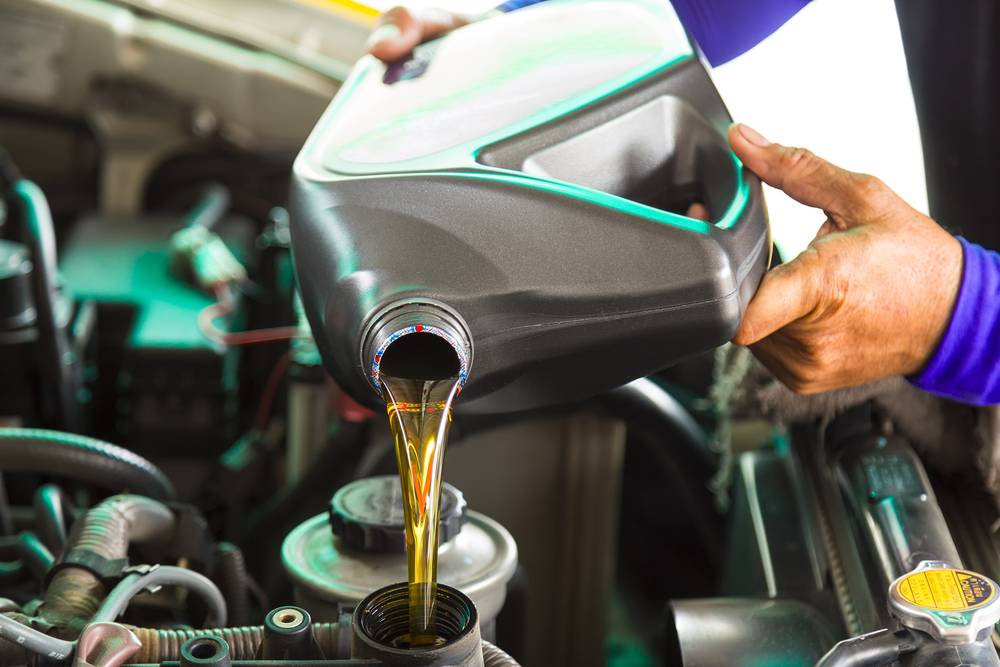
Processing storage space
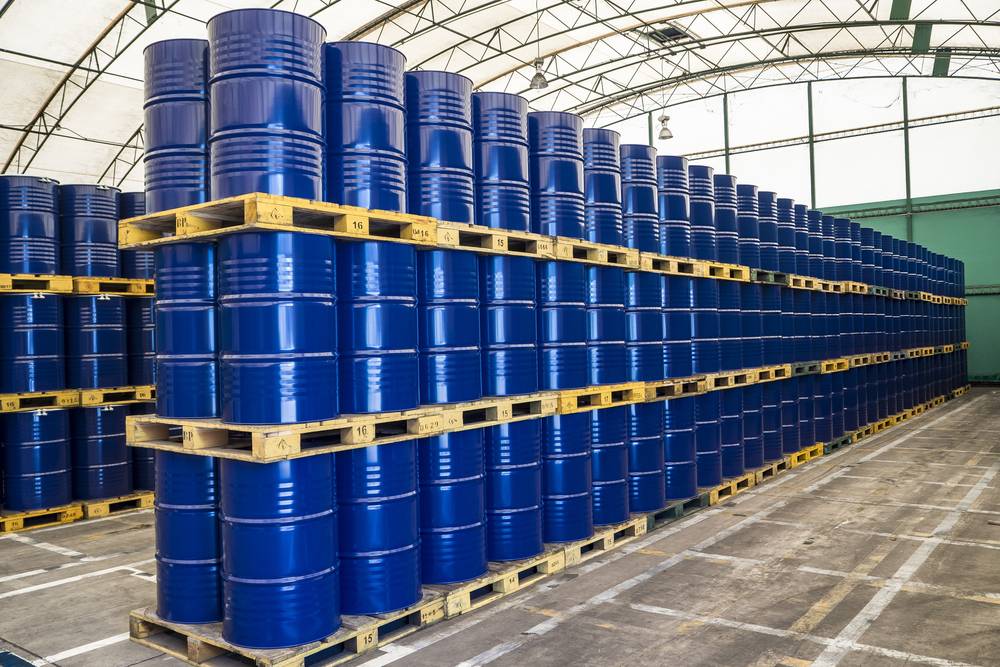
- ▸ Covered place (umbrella) so that barrels are not exposed to high heat, humidity and rain
- ▸ Good ventilation
- ▸ Solid floor
- • Dedicated space to store each item individually (storage capacity)
- ▸ Fire resistance devices
- ▸ There is a card for each item
- ▸ Amin Store Keeper
warehousing
- ▸ Solid floor – wood drums
- ▸ Small canisters often have three stacks
- • Barrels of oils are stored horizontally not more than five stacks and the two medicines are in a horizontal position until covered with oil to prevent moisture from leaking inside the barrels due to different pressure as a result of changing temperatures
- ▸ Grease barrels store vertical in just two stacks
- ▸ Storage on multilayered horizontal shelves (ramp and non-sloping shelves)
Trading
- • The required item is exchanged either barrels or small containers
- • Modern download and download tools are used to avoid risks (fork punch – simple runway – multi-string and multi-chained runway)
- • During trading, be careful of pollution
- • Protective devices should be used for warehouse workers
- • After withdrawing the required quantity of oil barrels, the barrel must be closed well
- • When withdrawing the required quantity of grease barrels, the surface of the barrel must be equal so that grease is not exposed to the process of separating the oil
In case of a complaint, the following must be followed:
- Reservation of the pile in question
- Identification of cubist islands for the quantity in question
- Withdrawal of three samples of the barrel by a committee of the two companies
- Analysis of a sample by our company and analysis of a sample by the client and the reservation of the third sample for analysis in a neutral body
- Comment on the results of the tests and if the complaint is confirmed, the quantity is withdrawn and a quantity is supplied instead.
Product control
(Production – Storage – Trading)
- Production: Good monitoring prior to production processes of basic oil matching, additives and control during manufacturing from the chemical plant of the production centers.
- Storage: Good storage as mentioned earlier to preserve the product.
- Trading during transport and use: Accuracy must be taken into account when receiving items, during transport, using recommended items and maintaining them from pollution (dust- rain – mixing one item with another).
Abstract
- Receipts, storage and trading provided
on them for recommended items that you should follow
And commitment to it from all stakeholders leads to
Optimal use of oils and grease and no complaint of these items